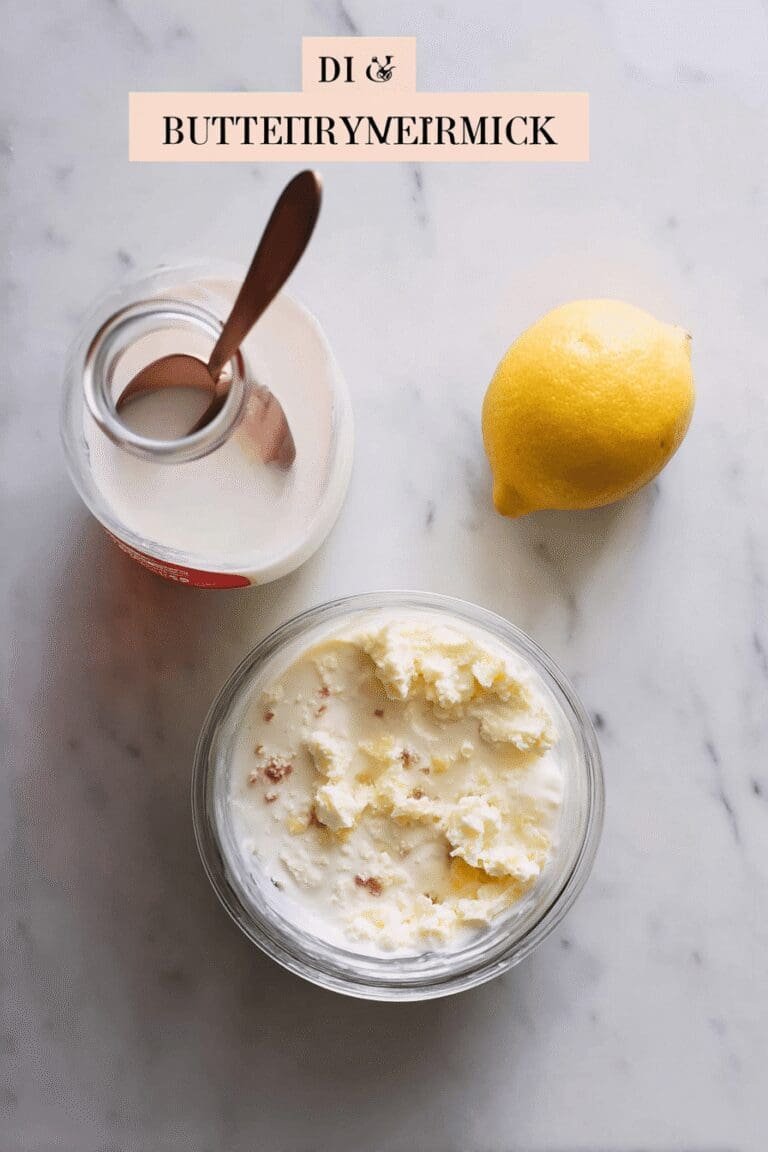
Ingredients
– 2 teaspoons white vinegar or fresh lemon juice
– Whole milk (enough to reach the 1 cup line after adding the acid; approximately 1 cup minus 2 teaspoons of milk)
– 1 cup milk acts as the base providing creaminess and texture
– 1 tablespoon lemon juice or white vinegar adds acidity to mimic the sourness of buttermilk
– 1/4 cup plain yogurt enhances creaminess and tanginess
– 1/2 teaspoon cream of tartar stabilizes the mixture and aids in acidity
Instructions
1-Second: measure 1 cup of milk and place it in a mixing bowl or measuring cup.
2-Third: add 1 tablespoon of lemon juice or white vinegar to the milk and stir gently. The acidity here is crucial, as it mimics buttermilk’s role in activating baking soda for leavening.
3-Pour the 2 teaspoons of vinegar or lemon juice into a liquid measuring cup.
4-Add whole milk up to the 1 cup mark.
5-Stir gently and let sit for 5 minutes until the milk is slightly curdled. It is then ready to use.
6-Fourth: let the mixture sit for 5 to 10 minutes at room temperature to curdle and thicken slightly, creating that essential acidic effect.
7-Fifth: if desired, mix in 1/4 cup of plain yogurt or 1/2 teaspoon cream of tartar to boost tanginess and texture.
8-Sixth: stir the mixture again before use to ensure uniformity.
9-Final step: Use your freshly made buttermilk substitute immediately in recipes or refrigerate for up to 24 hours. This method works well for most baking, and from my tests, it’s nearly as effective as real buttermilk for items like pancakes or breads.
Last Step:
Please leave a rating and comment letting us know how you liked this recipe! This helps our business to thrive and continue providing free, high-quality recipes for you.Notes
⚡ For best results, use whole milk in the vinegar/lemon juice substitute for proper moisture and richness.
🥄 Avoid using non-fat milk as it yields dry, dense baked goods.
❄️ Buttermilk can be frozen for up to 3 months; thaw and stir before using.
- Prep Time: 5 minutes
- Category: Baking Tips
- Method: Mixing